Clinical + Market Trends
Does Finerenone Meaningfully Change HFmrEF/HFpEF Care After SGLT2 Uptake in Malaysia?
Posted on 3 July 2026 7 mins read

This content is intended for healthcare professionals as clinical decision-support education. It supports, but does not replace, independent clinical judgement.
Finerenone has now entered the heart failure with mildly reduced ejection fraction and heart failure with preserved ejection fraction (HFmrEF/HFpEF) treatment conversation in Malaysia, forcing clinics to decide whether this is simply another option or a genuine addition to phenotype-directed care. The key specialist question is not whether finerenone works at all, but which patients derive the most practical incremental benefit once sodium-glucose cotransporter-2 (SGLT2) inhibitors, diuretics, blood pressure control, atrial fibrillation (AF) management, and comorbidity treatment are already in place.
Residual Risk Persists Despite Contemporary HFpEF/HFmrEF Care
The immediate Malaysian relevance is regulatory as well as clinical. The National Pharmaceutical Regulatory Agency (NPRA) published an approved additional indication for finerenone in May 2026, extending local prescribing language to adults with heart failure and left ventricular ejection fraction (LVEF) of at least 40%, which aligns with the FINEARTS-HF trial population. That matters because the unresolved problem in HFmrEF/HFpEF clinics is not absence of therapy, but persistent worsening heart failure events despite broader use of SGLT2 inhibitors and conventional symptom control.
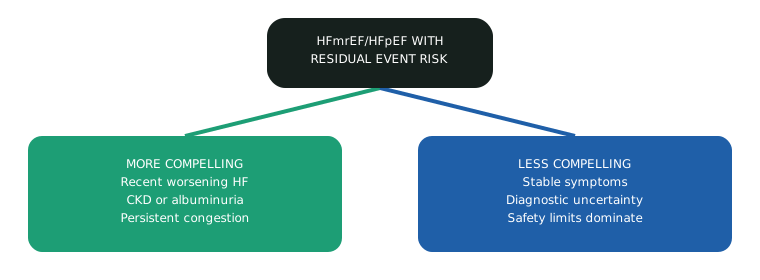
In FINEARTS-HF, finerenone was tested precisely in this space: symptomatic heart failure with LVEF at least 40%. Evidence synthesis indicates that the most persuasive clinical niche is not the stable minimally symptomatic patient, but a higher residual-risk cardio-renal-congestive phenotype, especially those with recent worsening heart failure, chronic kidney disease (CKD), albuminuria, persistent congestion, or repeated outpatient decompensation. This is a selection problem as much as an efficacy problem.
What FINEARTS-HF Actually Added, and What It Did Not
The core evidence comes from the randomised FINEARTS-HF trial, which showed that finerenone reduced the primary composite of cardiovascular death and total worsening heart failure events versus placebo in patients with mildly reduced or preserved ejection fraction. Across the current literature, the signal is interpreted as being driven mainly by fewer worsening heart failure events rather than a clear stand-alone mortality effect. For specialists, this distinction is crucial: the likely value proposition is event reduction, symptom trajectory, and service utilisation, not a simple mortality narrative.
FINEARTS-HF · Potassium Signals
JAMA Cardiology 2025
HR 0.46
Potassium <3.5 mmol/L with finerenone
HR 2.16
Potassium >5.5 mmol/L with finerenone
The potassium analysis sharpens implementation rather than undermining it. In 6,001 FINEARTS-HF participants, finerenone increased mean serum potassium and raised the risk of potassium above 5.5 mmol/L, but it also reduced hypokalaemia below 3.5 mmol/L. Both hyperkalaemia and hypokalaemia were associated with worse subsequent outcomes, yet the overall clinical benefit of finerenone remained with protocol-directed surveillance and dose adjustment.
Prespecified kidney-risk analysis further suggests that benefit was broadly consistent across kidney-risk strata, with higher kidney risk associated with higher event rates, implying greater absolute rather than necessarily differential relative benefit in cardiorenal-heavy clinics. Review commentary from the post-trial literature therefore positions finerenone less as a universal replacement for older mineralocorticoid receptor antagonist (MRA) practice, and more as a non-steroidal MRA option whose practical role depends on phenotype, monitoring capacity, and residual risk after background therapy.
Which Metrics Should Trigger Consideration in Clinic
The minimum clinical frame is straightforward: symptomatic HFmrEF/HFpEF with LVEF at least 40%, objective evidence supporting the diagnosis, and enough residual risk to justify another monitored cardiorenal drug. Evidence synthesis indicates that the most useful trigger is recent worsening heart failure, such as prior admission, urgent intravenous diuresis, recurrent congestion, escalating loop diuretic need, or repeated outpatient deterioration.
Kidney metrics matter twice, first as enrichment and second as safety. Lower estimated glomerular filtration rate (eGFR), CKD, and especially albuminuria identify a cardio-renal phenotype with higher event rates in whom absolute gain may be larger. However, initiation should only be considered when eGFR is at least 25 mL/min/1.73 m² and serum potassium is 5.0 mmol/L or lower, according to the evidence synthesis based on current heart failure labelling and trial entry logic. AF and obesity-related congestion are useful as burden markers, but neither should be treated as a proven treatment-effect modifier on its own.
| Metric | Why It Matters | How to Use It |
|---|---|---|
| LVEF ≥40% | Matches the FINEARTS-HF population | Confirms alignment with trial evidence |
| Recent worsening HF | Strongest bedside marker of higher absolute event risk | Prioritise over stable low-burden cases |
| eGFR and albuminuria | Identify cardiorenal phenotype and influence safety | Enrich for benefit, but screen for initiation limits |
| Serum potassium | Central implementation constraint | Do not start if potassium is above 5.0 mmol/L |
Why Non-steroidal MRA Signalling May Matter
The mechanistic argument, as far as the supplied sources support it, is that finerenone targets non-steroidal mineralocorticoid receptor antagonism in a syndrome where fibrosis, inflammation, and cardiorenal interaction remain active despite conventional haemodynamic control. This helps explain why the most persuasive candidate is not simply a patient with preserved ejection fraction, but one with a congestion-prone, CKD-linked, or albuminuric phenotype in whom residual risk appears biologically and clinically plausible.
Importantly, current evidence does not support claiming a narrow responder subgroup. The effect appears broadly consistent across enrolled strata, including kidney-risk groups and body mass index categories, which argues more for risk enrichment than for precision exclusion.
How to Layer Finerenone and Monitor It Safely
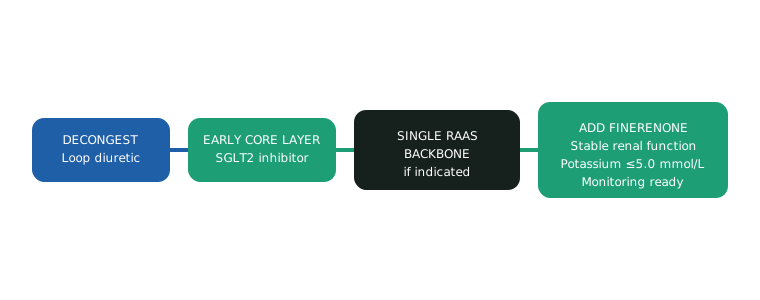
Across the current literature, a pragmatic sequencing model is consistent: optimise congestion first, introduce an SGLT2 inhibitor early, maintain only one background RAAS-active agent if indicated, and add finerenone only after potassium is normal and renal function is stable enough for surveillance. This is not because finerenone lacks efficacy, but because staged initiation reduces diagnostic ambiguity when creatinine or potassium later moves.
For symptomatic HFmrEF/HFpEF with eGFR 25–59 mL/min/1.73 m², evidence synthesis indicates that finerenone can be started if eGFR is at least 25 and serum potassium is not above 5.0 mmol/L, using 20 mg once daily in this renal function band. Baseline serum potassium and creatinine or eGFR should be checked before initiation, repeated at 4 weeks, repeated again 4 weeks after any dose change, and then monitored periodically thereafter, with closer follow-up when hyperkalaemia risk is higher. The secondary potassium analysis supports this surveillance-heavy implementation model by showing that benefit can be preserved despite more potassium excursions when protocol-led adjustment is used.
Evidence synthesis also cautions against routine dual RAAS blockade or combining finerenone with another MRA, framing finerenone instead as an adjunct layered onto, not stacked indiscriminately with, other potassium-raising therapies.
What Should Change in Specialist Workflow Now
For Malaysian heart failure services, the practical consequence of the new indication is not that every eligible HFmrEF/HFpEF patient now needs finerenone immediately. Rather, clinics need a reproducible phenotype-and-monitoring pathway. The best near-term candidates are those with recent worsening heart failure, recurrent congestion, CKD, and especially albuminuria, provided potassium and renal thresholds permit safe initiation. In that group, the likely return is fewer worsening heart failure events and better control of residual cardiorenal risk, not a guaranteed mortality signal.
- AF:
- atrial fibrillation ;
- CKD:
- chronic kidney disease ;
- eGFR:
- estimated glomerular filtration rate ;
- HF:
- heart failure ;
- HFmrEF:
- heart failure with mildly reduced ejection fraction ;
- HFpEF:
- heart failure with preserved ejection fraction ;
- LVEF:
- left ventricular ejection fraction ;
- MRA:
- mineralocorticoid receptor antagonist ;
- NPRA:
- National Pharmaceutical Regulatory Agency ;
- RAAS:
- renin-angiotensin-aldosterone system ;
- SGLT2:
- sodium-glucose cotransporter-2