Evidence-Led Case Study
Azithromycin in Structural Heart Disease: A Case-Based Approach to Short-Course Arrhythmic Risk
Posted on 3 July 2026 8 mins read

This content is intended for healthcare professionals as clinical decision-support education. It supports, but does not replace, independent clinical judgement.
In patients with heart failure (HF) or other structural heart disease, the clinical question is rarely whether azithromycin is universally unsafe. It is whether baseline electrocardiographic, electrolyte, and drug-related vulnerability makes a short course of a QT-active antibiotic an avoidable hazard, despite mixed observational estimates of cardiovascular death in broader populations.
Summary and Introduction
Azithromycin remains attractive in respiratory infection because of dosing convenience and familiarity, yet concern persists because azithromycin can prolong cardiac repolarisation and has been linked to torsades de pointes and potentially fatal arrhythmia in susceptible patients. The best-known signal came from Ray and colleagues, who reported an increased risk of cardiovascular death during a 5-day azithromycin course compared with amoxicillin, with the excess most apparent in patients at high baseline cardiovascular risk. Later cohort analyses have been less consistent, including a Danish study that did not show an increased risk versus penicillin V in a younger and healthier population, and a large US integrated-care analysis that reported an association between azithromycin exposure and cardiovascular mortality but with different design features and comparator structures.
Across the current literature, evidence synthesis indicates that the practical concern has not disappeared, because effect estimates vary with comparator choice, confounding by indication, and the burden of baseline arrhythmic risk. A 2023 meta-analysis further supports a class-level signal, reporting increased cardiovascular risk with macrolide exposure, albeit with heterogeneity across studies. For specialists, this leaves a bedside problem rather than a purely epidemiological one: identifying the patient in whom a small average absolute risk becomes clinically unacceptable.
Key Signal
Ray et al. versus later cohorts
Early signal
Higher cardiovascular death during 5-day azithromycin exposure versus amoxicillin in a high-risk Medicaid cohort.
Later data
Smaller or inconsistent estimates across other observational settings, without fully removing concern in high-risk cardiac patients.
Patient Case Presentation
A Malay man in his late 60s with chronic heart failure with reduced ejection fraction, prior ischaemic heart disease, and paroxysmal atrial fibrillation presented with 3 days of cough, low-grade fever, and increasing exertional dyspnoea. His regular medicines included a loop diuretic, beta-blocker, and amiodarone. He was haemodynamically stable, but the resting pulse was 52 beats/min and there was mild bibasal crepitation without shock or severe respiratory distress. In a community or emergency setting, azithromycin would be a familiar option for presumed community-acquired lower respiratory infection, yet this profile immediately raises concern for accumulated proarrhythmic liability rather than antibiotic convenience alone.
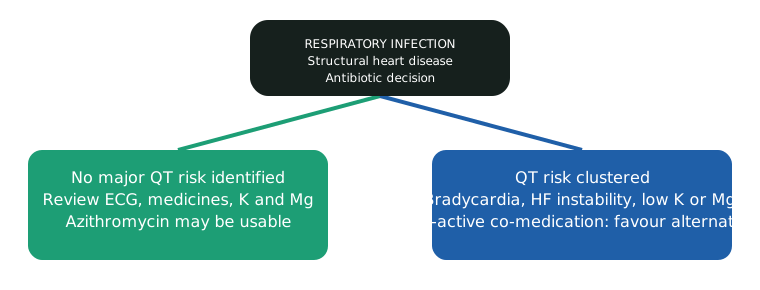
The immediate question was not simply whether infection was present, but whether a macrolide was justifiable in a patient with structural heart disease, bradycardia, diuretic exposure, and concurrent antiarrhythmic therapy. Evidence synthesis indicates that such clustering of risk factors should shift prescribing towards a non-QT-prolonging alternative when adequate microbiological coverage can be achieved.
Differential Diagnosis
The differential diagnosis included community-acquired pneumonia, acute bronchitic illness, and infection-triggered heart failure decompensation. The overlap matters because dyspnoea and pulmonary findings in HF may drive reflex antibiotic prescribing, while the same HF state also amplifies the consequence of an avoidable QT-active drug. A parallel therapeutic differential also had to be considered: whether atypical coverage was essential enough to justify azithromycin, or whether a non-macrolide option such as amoxicillin, amoxicillin-clavulanate, or doxycycline would be clinically adequate in line with syndrome-specific respiratory guidance cited in the evidence syntheses.
Investigations and Diagnosis
In this scenario, the key investigations are those that convert a theoretical warning into a measurable prescribing decision: electrocardiography, electrolyte review, and medication reconciliation. The FDA communication identifies known QT prolongation, clinically significant bradycardia, uncompensated HF, uncorrected hypokalaemia or hypomagnesaemia, and concomitant QT-prolonging agents, especially Class IA and Class III antiarrhythmics, as risk factors for potentially fatal rhythms with azithromycin. Across the Dx syntheses, a baseline corrected QT interval (QTc) of 500 ms or more is presented as a strong practical threshold to avoid QT-prolonging therapy, while 470–499 ms is treated as a caution zone rather than an azithromycin-specific label cut-off. This is a synthesis-based risk standard rather than a number stated in the FDA communication, and should therefore be interpreted cautiously against local protocol.
| Assessment | Diagnostic Implication |
|---|---|
| Electrocardiogram with QTc review | Known QT prolongation or marked QTc elevation supports avoiding azithromycin if an effective alternative exists. |
| Heart rate and rhythm review | Clinically significant bradycardia and antiarrhythmic therapy increase proarrhythmic susceptibility. |
| Serum potassium and magnesium | Uncorrected hypokalaemia or hypomagnesaemia are explicit avoid features until corrected. |
| Medication reconciliation | Concurrent QT-prolonging drugs, especially Class IA or Class III agents, shift the balance towards a non-QT-liable antibiotic. |
For the educational case, the working diagnosis is community-acquired respiratory infection in a patient with structural heart disease and high baseline arrhythmic risk. The infection itself may still merit antibiotic therapy, but azithromycin is not the neutral choice in this context.
Treatment and Management
The management priority is comparator selection. In a patient already receiving amiodarone, with bradycardia and likely diuretic-associated electrolyte vulnerability, azithromycin should generally be avoided in favour of a non-QT-prolonging alternative when clinically appropriate for the suspected respiratory syndrome. The Dx evidence syntheses cite oral alternatives such as amoxicillin, amoxicillin-clavulanate, or doxycycline depending on syndrome, allergy status, and local guidance, while also cautioning against simply replacing azithromycin with another QT-active agent.
If azithromycin is still being considered because of a specific microbiological rationale, risk mitigation should be deliberate: obtain a baseline electrocardiogram, review interacting medicines, correct potassium and magnesium before the first dose, avoid use during active decompensated HF, and consider repeat electrocardiographic monitoring in higher-risk inpatients. In the present case, choosing a non-macrolide regimen and reassessing volume status, electrolytes, and rhythm burden would better align with the total torsades risk profile than proceeding with a familiar short-course macrolide.
Case Discussion
This case reflects why the azithromycin safety debate still matters in cardiology practice. Ray et al showed a signal for excess cardiovascular death during current azithromycin exposure, whereas later cohorts produced smaller or null estimates in other populations. That divergence should not be read as exoneration. The datasets differ materially in age, baseline risk, comparator antibiotic, and the likelihood that infection severity or indication influenced prescribing. The arrhythmic mechanism remains biologically plausible, reinforced by regulatory warnings and by broader literature suggesting increased ventricular arrhythmia or sudden cardiac death risk with macrolides as a class.
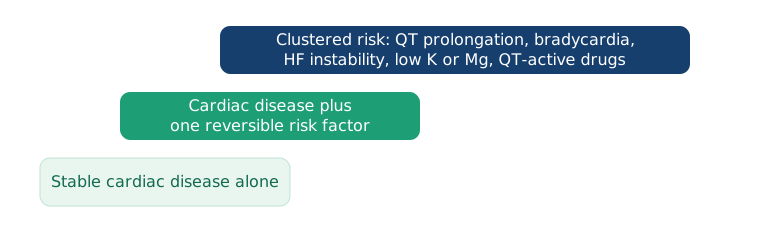
In practical terms, the important phenotype is not the average outpatient with no substrate, but the patient with HF, ischaemic heart disease, structural disease, prior ventricular instability, bradycardia, low potassium or magnesium, or concurrent QT-prolonging therapy. In Malaysian practice, the main friction point is not access to azithromycin but the ease with which a familiar antibiotic may be prescribed before electrocardiographic or electrolyte risk is fully reviewed. That framing is consistent with the supplied evidence, although any claim about national implementation patterns beyond this general observation would require additional local source data and is therefore not asserted here.
- AF:
- atrial fibrillation ;
- CAP:
- community-acquired pneumonia ;
- ECG:
- electrocardiogram ;
- HF:
- heart failure ;
- QTc:
- corrected QT interval